This package is the same release as 2026.6.822.0, with a fix for our RPM package. Previously the repository served a single build to every OS version, so an install could pull a dependency that isn't available on that release. The repository now serves the correct build for each operating system version, so installs automatically pull the dependencies that version requires. Debian and Ubuntu were not affected.
If you installed version 2026.6.822.0 on an RPM-based distribution, we recommend refreshing your repository configuration:
sudo curl -fsSL https://pkg.cloudflareclient.com/cloudflare-warp-ascii.repo | sudo tee /etc/yum.repos.d/cloudflare-warp.repo
sudo dnf clean all
sudo dnf install cloudflare-warp
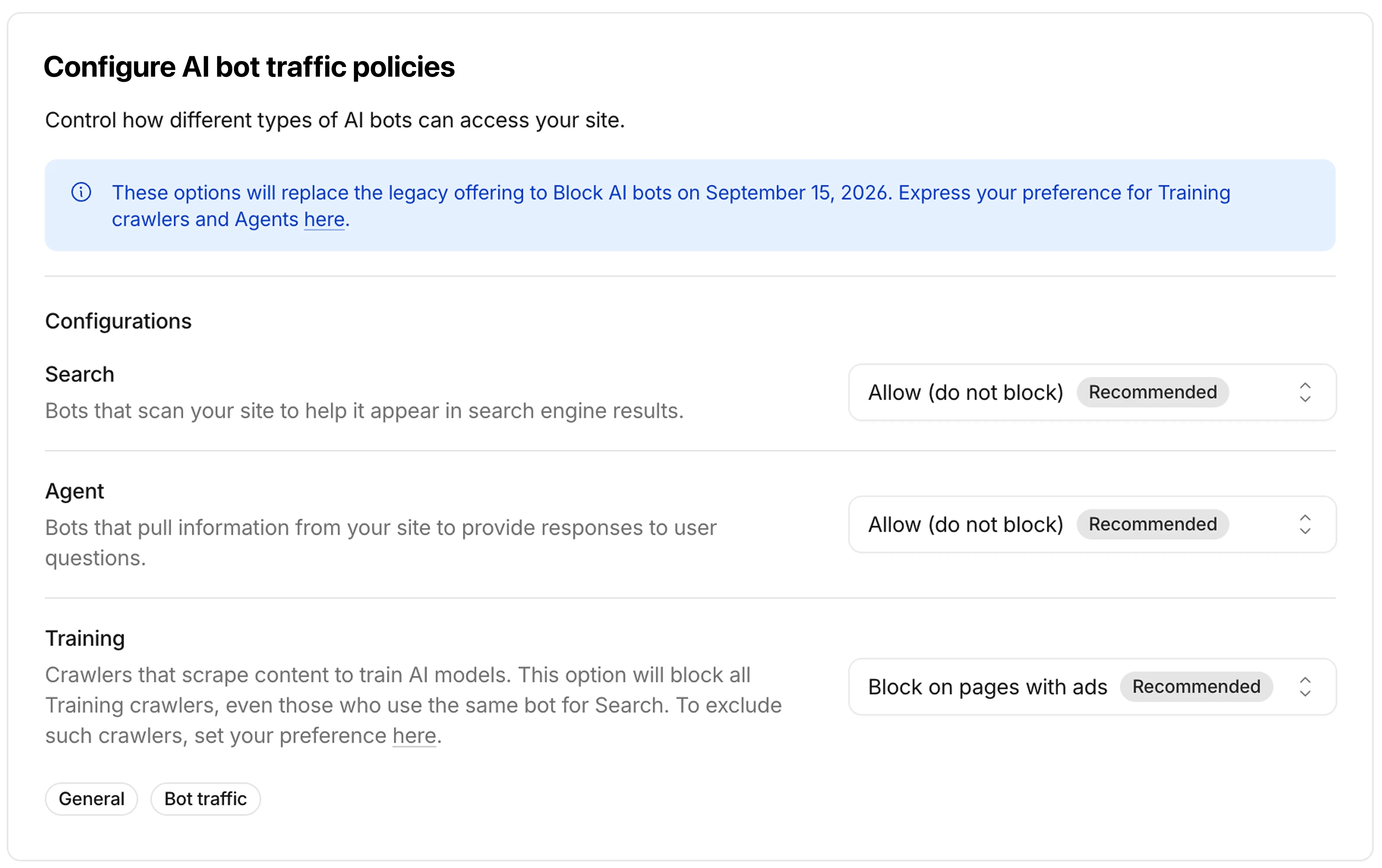
并非所有 AI 流量都是相同的。现在,所有客户(包括使用免费计划的客户)都可以根据 AI 爬虫在您网站上的实际行为来对其进行管理。Cloudflare 将 AI 流量归类为三种行为,您可以对其进行独立控制:搜索 (Search)、代理 (Agent) 和训练 (Training)。这可以让您保留为您带来读者和收入的自动化流量,同时屏蔽那些只获取您内容的流量。
This release introduces multiple features from our previous beta release into stable release, including:
The client now applies DNS search suffixes configured in your device profile / network policy. Administrators can push a list of DNS search domains that the client appends to single-label queries, alongside any system-configured suffixes. See DNS search suffixes for details.
Added mandatory authentication. When enabled via MDM, the Cloudflare One Client blocks all Internet traffic from the moment the machine boots until the user authenticates, closing the visibility gap on newly deployed devices and during re-authentication. See the announcement blog and documentation for details.
Upgraded security of device registration to be hardware-backed. Registration tokens can now be generated in the TPM (with TPM 2.0+) whenever it is available to provide stronger protection against device impersonation. See Hardware-backed registration for details.
Added a local-file signal source for Emergency Disconnect. In addition to the existing HTTPS polling mechanism, administrators can now configure WARP to monitor for a file on disk; the presence of the file triggers an emergency disconnect even if both Cloudflare and your own infrastructure are unreachable. Either signal being asserted triggers disconnect; both must be cleared for normal operation to resume.
Added new warp-cli debug commands for interactive connection diagnosis. See Extra debug logging for details.
The local DNS proxy now supports DNSSEC passthrough. DNSSEC-signed responses are forwarded to the application intact (including DO/AD bits and RRSIG records), so applications that validate DNSSEC locally — including resolvers and the dig/drill tooling — work correctly through the client.
Added a new MDM format for organization-wide settings, including a cleaner way to configure the compliance environment (e.g. FedRAMP). The previous per-configuration approach still works, but the new format is now recommended. See the updated Cloudflare One MDM documentation for details.
Added support for dashboard-managed client version deployments. Administrators can now upgrade or downgrade the client version on enrolled devices directly from the Zero Trust dashboard. See Client version assignments for details.
Additional Changes and improvements
Starting with 2026.6.822.0, the client unifies all API requests under the api.devices.cloudflare.com SNI, where previously both zero-trust-client.cloudflareclient.com and notifications.cloudflareclient.com were used. Review Cloudflare One Client with firewall to ensure systems that rely on SNI inspection do not block the API traffic. The behavior of previous client versions is unaffected.
Client Certificate device-posture checks now support template variables (e.g. ${serial_number}, ${device_uuid}) in the Subject Alternative Name field. Previously only the Common Name field accepted variables, which broke posture rules that pinned identity to a SAN entry.
Improved accessibility by using high contrast colors and more defined color boundaries when high contrast is enabled in Windows Accessibility settings.
Path MTU Discovery (PMTUD) is now enabled by default.
The UseWebView2 registry value (HKLM\SOFTWARE\Cloudflare\CloudflareWARP\UseWebView2 = y) is once again honored by the new GUI for authentication, so administrators who prefer the embedded WebView2 browser for sign-in can opt back in. This setting was effectively ignored in the previous release; the default browser was always used. This key is now also honored for re-authentications.
Fixed a crash in the authentication browser when navigating to a site that prompts for browser permissions (microphone, camera, notifications, etc.). The same fix had previously landed for the captive-portal browser; this extends it to the auth browser.
Fixed an issue in proxy mode where hostnames containing underscores (e.g. ai_app.com) were rejected, breaking apps that depend on such hostnames (notably ChatGPT sandbox apps). The local proxy now accepts underscore-containing hostnames in CONNECT requests.
Fixed an issue where DNS queries would fail after the connection was idle, requiring users to retry.
Fixed a high CPU issue when the device wakes from sleep.
Users can now register with team names in any case format without errors.
New UI fixes
Fixed an issue where users with invalid MDM configurations were returned to the onboarding screen after successful authentication.
Added a re-auth button and banner to the home screen so users don't miss it when their session expires.
Added clear error messaging when the Cloudflare certificate needs to be installed.
Brought back support for pausing the tunnel when connected to user-specified Wi-Fi networks for consumer users.
New client UI now surfaces Split tunnel configuration and Local Domain Fallback configuration.
Added ability to configure proxy mode for consumer users.
Added back the option to quit for consumer users.
Known issues
Single sign-on in the embedded WebView2 authentication browser may fail to use the Windows primary account, prompting for an interactive sign-in.
An error indicating that Microsoft Edge can't read and write to its data directory may be displayed during captive portal login; this error is benign and can be dismissed.
In rare cases, a registration may hang at "Checking your organization configuration" due to IPC errors. A system reboot should resolve the error, allowing registration to proceed.
Windows ARM may prompt the user to close running applications while trying to install this version. Simply click "Ok" with the default highlighted option.
This release introduces multiple features from our previous beta release into stable release, including:
The client now applies DNS search suffixes configured in your device profile / network policy. Administrators can push a list of DNS search domains that the client appends to single-label queries, alongside any system-configured suffixes. See DNS search suffixes for details.
Upgraded security of device registration to be hardware-backed. Registration tokens can now be generated in the Secure Enclave whenever available to provide stronger protection against device impersonation. See Hardware-backed registration for details.
Added a local-file signal source for Emergency Disconnect. In addition to the existing HTTPS polling mechanism, administrators can now configure WARP to monitor for a file on disk; the presence of the file triggers an emergency disconnect even if both Cloudflare and your own infrastructure are unreachable. Either signal being asserted triggers disconnect; both must be cleared for normal operation to resume.
Added new warp-cli debug commands for interactive connection diagnosis. See Extra debug logging for details.
The local DNS proxy now supports DNSSEC passthrough. DNSSEC-signed responses are forwarded to the application intact (including DO/AD bits and RRSIG records), so applications that validate DNSSEC locally — including resolvers and the dig/drill tooling — work correctly through the client.
Added a new MDM format for organization-wide settings, including a cleaner way to configure the compliance environment (e.g. FedRAMP). The previous per-configuration approach still works, but the new format is now recommended. See the updated Cloudflare One MDM documentation for details.
Added support for dashboard-managed client version deployments. Administrators can now upgrade or downgrade the client version on enrolled devices directly from the Zero Trust dashboard. See Client version assignments for details.
Additional Changes and improvements
Starting with 2026.6.822.0, the client unifies all API requests under the api.devices.cloudflare.com SNI, where previously both zero-trust-client.cloudflareclient.com and notifications.cloudflareclient.com were used. Review Cloudflare One Client with firewall to ensure systems that rely on SNI inspection do not block the API traffic. The behavior of previous client versions is unaffected.
Client Certificate device-posture checks now support template variables (e.g. ${serial_number}, ${device_uuid}) in the Subject Alternative Name field. Previously only the Common Name field accepted variables, which broke posture rules that pinned identity to a SAN entry.
Improved accessibility by using high contrast colors and more defined color boundaries when high contrast is enabled in the macOS Display settings.
Path MTU Discovery (PMTUD) is now enabled by default.
Fixed the in-client captive-portal browser rendering a blank "Success" page on some airline Wi-Fi networks. The browser now more consistently loads the airline's real portal page so users can complete sign-in from inside the client instead of having to open a separate browser.
Fixed an issue in proxy mode where hostnames containing underscores (e.g. ai_app.com) were rejected, breaking apps that depend on such hostnames (notably ChatGPT sandbox apps). The local proxy now accepts underscore-containing hostnames in CONNECT requests.
Fixed an issue where DNS queries would fail after the connection was idle, requiring users to retry.
Users can now register with team names in any case format without errors.
New UI fixes
Fixed an issue where users with invalid MDM configurations were returned to the onboarding screen after successful authentication.
Added a re-auth button and banner to the home screen so users don't miss it when their session expires.
Added clear error messaging when the Cloudflare certificate needs to be installed.
Brought back support for pausing the tunnel when connected to user-specified Wi-Fi networks for consumer users.
New client UI now surfaces Split tunnel configuration and Local Domain Fallback configuration.
Added ability to configure proxy mode for consumer users.
Added back the option to quit for consumer users.
Known issues
Registration may hang at "Checking your organization configuration" due to IPC errors. A system reboot should resolve the error, allowing registration to proceed.
When deploying with Microsoft Intune, the client may be repeatedly reinstalled because Intune adds the client's embedded framework bundles to its install-detection list, and those frameworks cannot be detected as installed on their own. See Repeated reinstalls on macOS with Microsoft Intune for the workaround.
This release introduces multiple features from our previous beta release into stable release, including:
The client now applies DNS search suffixes configured in your device profile / network policy. Administrators can push a list of DNS search domains that the client appends to single-label queries, alongside any system-configured suffixes. See DNS search suffixes for details.
Upgraded security of device registration to be hardware-backed. Registration tokens can now be generated in the TPM (with TPM 2.0+) whenever it is available to provide stronger protection against device impersonation. See Hardware-backed registration for details.
Added a local-file signal source for Emergency Disconnect. In addition to the existing HTTPS polling mechanism, administrators can now configure WARP to monitor for a file on disk; the presence of the file triggers an emergency disconnect even if both Cloudflare and your own infrastructure are unreachable. Either signal being asserted triggers disconnect; both must be cleared for normal operation to resume.
Added new warp-cli debug commands for interactive connection diagnosis. See Extra debug logging for details.
The local DNS proxy now supports DNSSEC passthrough. DNSSEC-signed responses are forwarded to the application intact (including DO/AD bits and RRSIG records), so applications that validate DNSSEC locally — including resolvers and the dig/drill tooling — work correctly through the client.
Added a new MDM format for organization-wide settings, including a cleaner way to configure the compliance environment (e.g. FedRAMP). The previous per-configuration approach still works, but the new format is now recommended. See the updated Cloudflare One MDM documentation for details.
Additional changes and improvements
Starting with 2026.6.822.0, the client unifies all API requests under the api.devices.cloudflare.com SNI, where previously both zero-trust-client.cloudflareclient.com and notifications.cloudflareclient.com were used. Review Cloudflare One Client with firewall to ensure systems that rely on SNI inspection do not block the API traffic. The behavior of previous client versions is unaffected.
Cloudflare Mesh functionality using the Cloudflare One Client is now supported on RHEL 9 and 10.
Client Certificate device-posture checks now support template variables (e.g. ${serial_number}, ${device_uuid}) in the Subject Alternative Name field. Previously only the Common Name field accepted variables, which broke posture rules that pinned identity to a SAN entry.
Improved accessibility by using high contrast colors and more defined color boundaries when high contrast is enabled in the system display settings.
Path MTU Discovery (PMTUD) is now enabled by default.
Fixed the in-client captive-portal browser rendering a blank "Success" page on some airline Wi-Fi networks. The browser now more consistently loads the airline's real portal page so users can complete sign-in from inside the client instead of having to open a separate browser.
Fixed an issue in proxy mode where hostnames containing underscores (e.g. ai_app.com) were rejected, breaking apps that depend on such hostnames (notably ChatGPT sandbox apps). The local proxy now accepts underscore-containing hostnames in CONNECT requests.
Fixed an issue where DNS queries would fail after the connection was idle, requiring users to retry.
Fixed an issue where some Debian releases experienced inaccurate version reporting for posture checks.
Users can now register with team names in any case format without errors.
New UI fixes
Fixed an issue where users with invalid MDM configurations were returned to the onboarding screen after successful authentication.
Added a re-auth button and banner to the home screen so users don't miss it when their session expires.
Added clear error messaging when the Cloudflare certificate needs to be installed.
Brought back support for pausing the tunnel when connected to user-specified Wi-Fi networks for consumer users.
New client UI now surfaces Split tunnel configuration and Local Domain Fallback configuration.
Added ability to configure proxy mode for consumer users.
Added back the option to quit for consumer users.
For RHEL deployments, this release introduces a dependency on the Extra Packages for Enterprise Linux repository (EPEL). The EPEL repository provides packages that support the captive portal detection’s in-app browser authentication and system tray icon. See Getting started with EPEL for instructions on enabling EPEL.
Known issues
Registration may hang at "Checking your organization configuration" due to IPC errors. A system reboot should resolve the error, allowing registration to proceed.
可选的 ai 同级依赖。 根 agents and @cloudflare/codemode 运行时不再引用 AI SDK 类型,因此它们可以在不安装 ai / zod 的情况下打包;特定于 AI 的入口点在导入时仍然需要同级依赖。just-bash 同样移动到了仅由 skills bash 运行器使用的可选同级依赖中。